Key Highlights
- Experiential learning helps children understand concepts through real experiences, reflection and application.
- It builds critical thinking, creativity, collaboration, communication and problem-solving skills.
- It helps parents understand how child-centred education supports meaningful learning.
Introduction:
Children learn best when they can connect ideas with experiences. Instead of only memorising concepts, experiential learning encourages children to explore, question, reflect and apply their understanding in real situations.
This approach makes learning more meaningful because children are actively involved in the process. They observe, investigate, create, discuss and learn from outcomes, which helps them develop both academic understanding and life skills.
Key aspects of experiential learning include:
- Learning through hands-on experiences and exploration
- Connecting classroom concepts with real-world situations
- Developing confidence through reflection and problem-solving
- Building skills beyond academics, including communication and collaboration
What Is Experiential Learning in Education?
Experiential learning in education is an approach where children gain knowledge through direct experiences, reflection, discussion and practical application. It moves beyond traditional instruction by allowing learners to actively participate in the learning process at the best school.
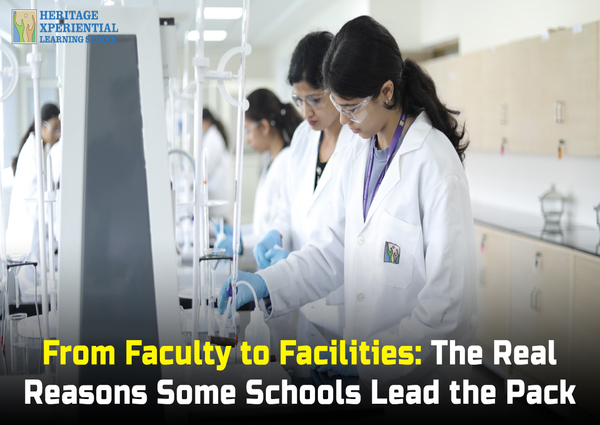
A science investigation, community study, theatre production, nature walk, design challenge or classroom project can become an experiential learning opportunity when children reflect on what they experienced and apply their learning to new situations.
A simple experiential learning cycle includes:
Experience → Reflection → Dialogue → Understanding → Application
Experience:
Children explore concepts through observation, experimentation, making or participation.
Reflection:
They think about their observations, decisions and learning outcomes.
Dialogue:
They exchange ideas, ask questions and learn from different perspectives.
Understanding:
They develop deeper conceptual clarity.
Application:
They use their knowledge in new situations.
Importance of Learning by Doing
Learning becomes more meaningful when children actively engage with concepts instead of simply receiving information. When students observe, create, test and improve, they develop a deeper understanding of why something works.
Experiential learning for children helps connect classroom knowledge with real-life situations. This makes concepts easier to remember, understand and apply. It also encourages children to become curious learners who are willing to ask questions, make mistakes and improve through feedback.
| Traditional Learning | Experiential Learning |
|---|---|
| Teacher explains concepts | Children investigate meaningful questions |
| Focus on recall | Focus on reasoning and application |
| Single correct responses | Multiple perspectives and solutions |
| Mistakes may feel discouraging | Mistakes become opportunities to improve |
Benefits of Experiential Learning for Children
The benefits of experiential learning go beyond academic performance. At The Best Schools located in Noida, through projects, discussions and real-world challenges, students learn how to think independently, communicate effectively and work with others.
Experiential learning for children helps develop:
Critical thinking: Making decisions based on observation, reasoning and evidence.
Creativity: Exploring different solutions, ideas and approaches.
Collaboration: Working together and respecting diverse viewpoints.
Communication: Expressing ideas through discussions, writing, presentations and creative formats.
Resilience: Learning from challenges and improving through feedback.
Responsibility: Understanding how choices affect people, communities and the environment.
These skills prepare children not only for examinations but also for real-world situations where they need to think, adapt and respond with confidence.
Examples of Experiential Learning
Experiential learning can be applied across subjects and age groups. It is not limited to science labs or practical activities; it can be part of languages, mathematics, social sciences, arts, technology and environmental studies.
Some examples include:
- Conducting science experiments to understand natural processes
- Creating models to explain mathematical concepts
- Participating in theatre to understand language, expression and emotion
- Visiting local communities to study social issues
- Designing solutions for environmental challenges
- Working on group projects that involve research, planning and presentation
- Reflecting on personal experiences through journals and classroom discussions
These experiences help children see learning as something connected to the world around them.
What Should Parents Look for in an Experiential Classroom?
Parents should look beyond whether a school conducts activities and focus on how those activities support learning outcomes. A meaningful experiential classroom is not about keeping children busy; it is about helping them learn with purpose.
A strong experiential classroom includes:
- Learning experiences connected to clear educational goals
- Teachers who encourage curiosity and meaningful questions
- Opportunities for children to research, create and present ideas
- Reflection activities that help students understand their learning journey
- Assessment methods beyond only written examinations
The goal is not simple participation. The real purpose is to help children develop deeper understanding through every experience.
FAQs:
1. What is experiential learning in education?
Experiential learning is an approach where children learn through direct experiences, reflection, discussion and applying knowledge in practical situations.
2. How is experiential learning different from traditional learning?
Traditional learning often focuses on instruction and memorisation, while experiential learning encourages children to explore concepts, solve problems and apply knowledge.
3. What are the benefits of experiential learning for children?
It helps children develop critical thinking, creativity, communication skills, confidence and the ability to solve real-world problems.
4. Is experiential learning only useful for practical subjects?
No. Experiential learning can be applied across subjects, including science, mathematics, languages, social sciences, arts and technology.
5. How can parents support experiential learning at home?
Parents can encourage curiosity by discussing everyday experiences, asking open-ended questions and allowing children to explore solutions independently.
6. Does experiential learning replace academic knowledge?
No. Experiential learning strengthens academic understanding by helping children apply concepts in meaningful contexts.
Conclusion:
Experiential learning makes education an active process where children explore, question, create and grow. It helps learners move beyond memorising information and develop the ability to understand, apply and connect knowledge with the world around them.
At Heritage Xperiential Learning School, one of the best schools in Noida, the Xperiential approach focuses on creating meaningful learning journeys where children engage deeply with concepts through inquiry, reflection and real-world connections. This child-centred philosophy helps nurture curious, confident and capable learners prepared for the challenges of tomorrow.