Key Highlights
- Experiential learning enhances critical thinking and problem-solving
- Activity-based approaches foster creativity, collaboration, and engagement
- Real-world projects and field experiences connect theory with practice
- Personalized guidance ensures every student explores their unique interests
- Integrated curriculum balances academics, co-curriculars, and life skills
Table of Contents
- Introduction
- About Us
- What Is Experiential Learning and Why Does It Matter?
- Activity-Based Learning: Making Education Interactive
- Benefits of Curiosity-Driven Learning
- Conclusion
- FAQs
Introduction:
In today’s education landscape, curiosity is no longer just a personality trait—it is a skill to be nurtured. At The Heritage, the Good Schools in Noida where students who question, explore, and experiment develop deeper understanding and resilience, better preparing them for academic challenges and real-world problem-solving. Traditional rote learning often limits this innate curiosity, while modern pedagogical approaches emphasize active engagement, inquiry, and experiential learning to cultivate lifelong learners.
About Us:
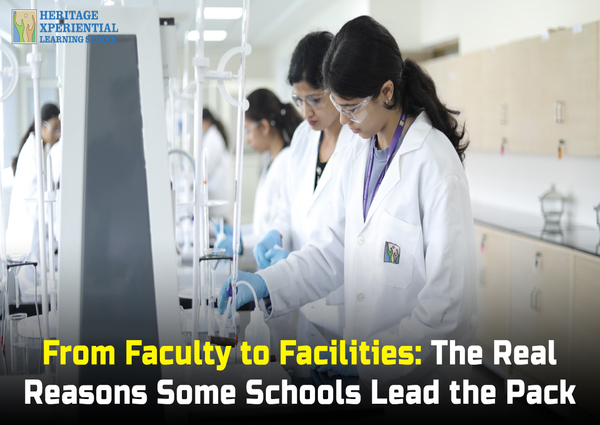
The Heritage School prioritizes a holistic, student-centered approach where academics meet exploration and creativity. Well-equipped science and arts labs, innovation hubs, libraries, and sports facilities provide the perfect environment for experiential learning. Teachers guide students through projects, workshops, and collaborative activities, fostering problem-solving, analytical thinking, and leadership. By combining structured curriculum with hands-on experiences, the school creates an ecosystem where curiosity thrives, paralleling best practices seen in good schools.
What Is Experiential Learning and Why Does It Matter?
How does experiential learning differ from traditional teaching?
Unlike conventional methods that focus on memorization, experiential learning emphasizes doing, reflecting, and applying. Students participate in real-world simulations, experiments, and field studies, which reinforce theoretical knowledge and spark inquiry.
Table: Experiential vs Traditional Learning
|
Aspect |
Experiential Learning |
Traditional Learning |
|
Approach |
Hands-on, inquiry-driven |
Lecture-based, rote memorization |
|
Engagement |
Active participation |
Passive listening |
|
Critical Thinking |
High, problem-solving oriented |
Limited, recall-based |
|
Real-world Application |
Immediate connection |
Abstract concepts only |
|
Creativity Development |
Encouraged and integrated |
Rarely emphasized |
At The Heritage School, students explore topics through experiments, simulations, and project-based learning. From coding a simple robot to testing scientific hypotheses, these experiences develop analytical thinking while making learning memorable and enjoyable.
Activity-Based Learning: Making Education Interactive
Why is activity-based learning essential for young minds?
Activities engage multiple senses and cognitive pathways, allowing students to retain knowledge more effectively. Art, drama, debates, science experiments, and collaborative games make abstract concepts tangible and stimulate curiosity.
Bullet Points: Key Strategies in Activity-Based Learning
- Hands-on experiments: Students apply theoretical knowledge in practical scenarios, improving comprehension and retention.
- Role-playing and simulations: Understanding history, social sciences, and civic concepts by experiencing them firsthand.
- Project-based assignments: Collaborative projects encourage research, planning, and teamwork.
- Outdoor learning: Field trips and community engagement connect classroom concepts with real-world environments.
- STEM integration: Coding, robotics, and engineering challenges promote logical thinking and innovation.
This multi-modal learning approach mirrors methodologies employed by other good schools, emphasizing active participation, teamwork, and reflection to enhance curiosity and competence.
Benefits of Curiosity-Driven Learning
What makes curiosity an essential 21st-century skill?
Curiosity encourages students to ask meaningful questions, explore alternatives, and challenge assumptions. Schools that promote this mindset equip students with skills beyond textbooks, preparing them for competitive exams, higher education, and future careers.
Bullet Points: Benefits
- Enhanced problem-solving: Students analyze situations, hypothesize, and test solutions.
- Creativity and innovation: Hands-on activities nurture originality and out-of-the-box thinking.
- Collaboration skills: Team projects build communication, empathy, and leadership.
- Resilience and adaptability: Learning from trial-and-error strengthens perseverance.
- Academic engagement: Interactive methods increase motivation and interest in core subjects.
By combining experiential and activity-based learning, The Heritage School ensures students are intellectually curious, socially responsible, and emotionally mature—qualities mirrored in top-performing schools.
Conclusion:
Encouraging curiosity through experiential and activity-based learning transforms the educational experience from passive absorption to active exploration. At The Heritage School, students are empowered to investigate, experiment, and engage deeply with their subjects, preparing them for academic excellence, competitive examinations, and global challenges. The school’s commitment to personalized mentorship, hands-on projects, and holistic development creates confident learners ready to succeed in any environment.
FAQs:
Q. 1 How does The Heritage School foster curiosity compared to other good schools?
Ans : Through hands-on projects, experiments, and inquiry-based learning.
Q. 2 Why are activity-based approaches important at The Heritage School?
Ans : They make concepts tangible, encourage creativity, and improve retention.
Q. 3 Do experiential programs help academic performance?
Ans : Yes, applying theory through experiments strengthens understanding and problem-solving skills.
Q. 4 How does The Heritage School integrate STEM and arts in learning?
Ans : Through coding clubs, robotics, music, and visual arts projects.
Q. 5 Can students develop leadership through experiential learning?
Ans : Yes, group activities and peer-led projects build confidence and collaboration.
Q. 6 Are these approaches aligned with top good schools?
Ans : Absolutely, they mirror best practices in holistic and inquiry-based education.